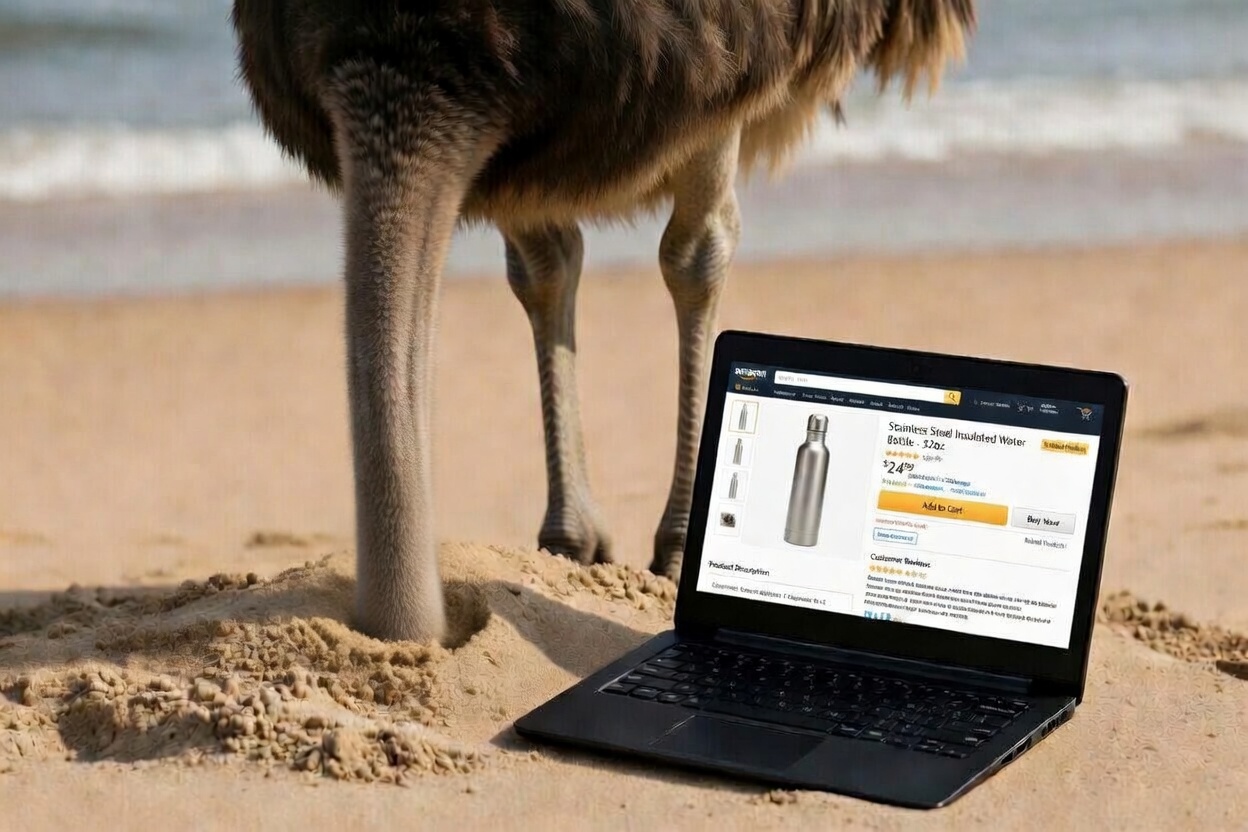
"We don't do Amazon."
We hear this from brand owners all the time. And we get it. Amazon can feel like the enemy — a marketplace that undercuts your retail pricing, invites unauthorized sellers to compete against you, and treats your brand like a commodity.
But here's the thing. Saying "we don't do Amazon" doesn't mean your brand isn't on Amazon. It means your brand is on Amazon without you. And that's worse.
The Ostrich Problem
Choosing not to engage with Amazon doesn't create a clean absence. It creates an uncontrolled presence — the same dynamic we explain in what uncontrolled success on Amazon looks like. Your products are already there — listed by distributors, sub-distributors, retail arbitrage sellers, and opportunistic resellers who saw a margin opportunity.
Without you in the picture, here's what's happening. Multiple sellers are competing on your listings, racing each other to the lowest possible price. Nobody is managing the content — the images are low quality, the descriptions are inaccurate, and there's no A+ Content or Brand Store. Nobody is running advertising, which means your competitors are showing up when customers search for your brand name. Nobody is monitoring for counterfeit or expired product. And every negative customer experience is attributed to your brand, not to the random seller who caused it.
This isn't a hypothetical. This is what we find when we audit brands that have been "ignoring" Amazon for years. The longer you wait, the messier it gets.
The Problem Compounds
Amazon's algorithm rewards consistency and momentum. Sellers who have been on your listings for years have accumulated reviews, sales history, and ranking signals that give them an entrenched position. The longer unauthorized sellers operate unchecked, the harder and more expensive it becomes to displace them.
Meanwhile, every month of inaction means more pricing erosion bleeding into your retail and DTC channels. More customers discovering your products through terrible listings that misrepresent your brand. More competitors gaining ground because they took Amazon seriously and you didn't. How neglecting Amazon costs you customers everywhere breaks down that pattern.
The compounding effect is real. A problem that would have taken 3 months to fix a year ago now takes 6 months and significantly more investment. Waiting another year makes it worse again.
Why Brands Resist
We understand the resistance. Amazon has real downsides for brands. The platform gives enormous power to third-party sellers. Pricing is transparent and competitive. Unauthorized sellers are hard to remove — see how unauthorized sellers hurt your brand for the full picture. And the fee structure is complex.
But the resistance usually comes from comparing Amazon to an ideal scenario where your products simply don't exist on the platform. That scenario doesn't exist. The real comparison is between an Amazon presence you control and an Amazon presence controlled by people who don't work for you, don't answer to you, and don't care about your brand.
When you frame the decision that way, the answer becomes clear. Controlled presence beats uncontrolled presence every time.
What Taking Control Looks Like
Taking control of your Amazon presence doesn't mean you have to become an Amazon expert overnight. It means making a deliberate decision to manage the channel instead of ignoring it.
For some brands, that means building an internal team to manage Amazon operations. For others, it means finding a partner who specializes in Amazon brand management. For many, it means starting with the fundamentals — enrolling in Brand Registry, auditing your listings, identifying unauthorized sellers, and tightening your distribution agreements.
The specifics depend on your situation. But the first step is always the same: stop pretending Amazon doesn't exist and start treating it as the strategic channel it already is — whether you chose it or not. Read signs you need help with Amazon when DIY Seller Central stops scaling.